
Written by Andrea Lovecchio, Francesca Sveva Composto and Edoardo Morsillo | Editor: Daniel Semotan
Italy has long been home to some of the world’s most influential luxury maisons, yet it has historically lacked the consolidated corporate power seen in France. That dynamic may be shifting. Prada Group’s €1.25bn acquisition of Versace, which was announced in early 2025, is not just a portfolio move, but a landmark moment for Italy’s fashion industry. It signals the beginning of a more unified, globally competitive Italian luxury ecosystem, positioning Prada, Miu Miu, and Versace as a triad capable of challenging giants such as LVMH and Kering.
The transaction arrives at a time of market normalisation, macro uncertainty, and pressure on mid-tier luxury brands, making it both opportunistic and symbolic. By bringing Versace “back home”, Prada aims to revive one of Italy’s most recognisable fashion names while strengthening its own strategic footprint across the global luxury landscape.
Deal Fundamentals
The centrepiece of the transaction is the €1.25bn valuation. A price that balances ambition with pragmatism. Capri Holdings, Versace’s American parent company, initially sought €1.45–1.5bn. Prada secured a roughly €180m discount (13–17% below initial expectations), reflecting the softer luxury environment in 2024 and Versace’s uneven performance.
Versace’s financials illuminate the downturn. The brand generated around $1.03bn in sales in 2024, an 8% year-on-year decline. Operating income fell sharply to just $25m, down from $152m in 2023 as a result of weaker retail trends, heavier promotions, and eroded margins. These pressures weighed on Capri Holdings, which entered 2025 with approximately $1.5bn in debt and increasing integration demands following its own $8.5bn acquisition by Tapestry.
Against this backdrop, Prada’s timing is strategic. The brand retains extraordinary global recognition (particularly in the US and Asia), and its long-term equity remains intact despite short-term volatility. Prada is betting that disciplined brand management, creative renewal, and operational restructuring can restore Versace’s profitability. The group’s track record under Andrea Guerra suggests a clear intent: strengthen margins, reduce volatility, and build scale.
Valuation Context
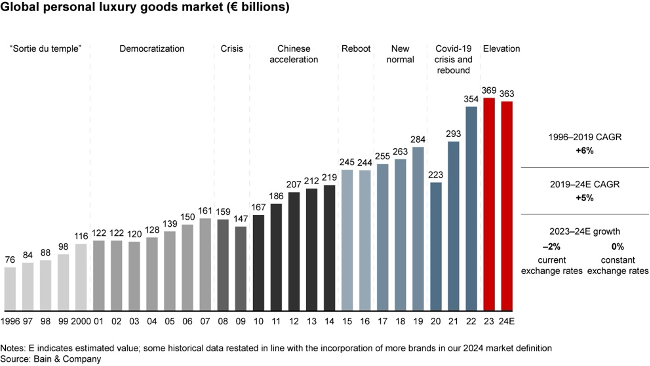
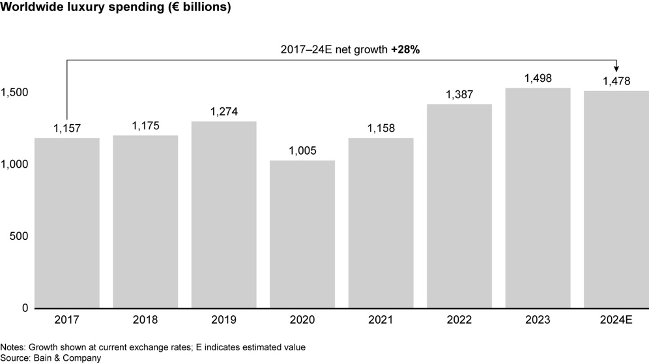
The €1.25bn price corresponds to an EV/Sales multiple of approximately 1.6x — below recent luxury transactions and trading multiples of comparable brands. Valentino’s 2023 stake sale, for example, priced the business at around 2.3x sales. Listed peers such as Ferragamo, Kering, and Brunello Cucinelli typically trade between 1.8x and 2.5x. The industry’s slowdown in China, coupled with higher interest rates, pushed valuations lower in 2024. Bain & Company reported just 4% global luxury market growth that year, with consumers gravitating either toward ultra-luxury or affordable luxury. Within this environment, Prada effectively capitalised on temporary weakness to acquire a globally recognised brand at a cyclical discount.
Financing and Strategic Rationale
Prada entered the deal with around €600m in net cash and is expected to finance the remainder through new debt while maintaining balance-sheet flexibility. Capri, in turn, gains liquidity and strategic clarity as it shifts focus toward North American integration under Tapestry. For Prada, the acquisition reinforces a broader ambition: to create a consolidated Italian luxury group capable of competing on scale, brand diversity, and global reach. For Capri, the sale is a recalibration after years of expansion.
Building an Italian Powerhouse
The acquisition represents more than financial engineering, as it is a cultural and strategic statement. Italian fashion has historically been fragmented, defined by independent maisons such as Armani, Valentino, and Ferragamo. While creatively rich, this fragmentation limited Italy’s ability to rival France’s corporate champions.
Prada seeks to change this paradigm. By integrating Prada, Miu Miu, and Versace under one roof, the group is effectively constructing an Italian luxury platform with enough scale, aesthetic breadth, and operational depth to compete globally.
A Unified Italian Luxury Identity
The three brands offer complementary identities:
- Prada — minimalist modernism and intellectual design
- Miu Miu — youthful, experimental femininity
- Versace — bold sensuality and high-octane glamour
Together, they capture a uniquely wide spectrum of the luxury consumer base. This mirrors the multi-brand strategies of Kering and LVMH, but with a distinctly Italian character rooted in heritage craftsmanship and design culture.
CEO Andrea Guerra has been explicit about the group’s ambition: consolidate Italy’s luxury icons to ensure global competitiveness. Miuccia Prada echoed this sentiment, describing the deal as “necessary to ensure that Italian luxury remains Italian”.
The symbolism of Versace returning to Italian ownership is powerful. Donatella Versace emphasised this directly, noting that joining Prada “keeps Versace’s heart beating stronger”. In a European context, it aligns with ongoing debates on safeguarding cultural industries from foreign acquisition and reinforces Milan’s position as a global fashion capital.
Strategic Advantages of Integration
The consolidation strengthens Prada Group in several areas:
- Resilience: Versace’s ready-to-wear and lifestyle strength balances Prada’s core in leather goods.
- Demographic expansion: Versace expands the group’s reach among younger, celebrity-driven audiences.
- Digital growth: Miu Miu’s digital-native following can reinforce Versace’s online presence.
- Operational scale: Shared manufacturing, logistics, and retail networks boost efficiency.
For the first time, Italy possesses a multi-brand group capable of challenging France’s luxury dominance.
Integration & Outlook
The acquisition’s long-term success will hinge on integration, historically the most challenging phase of luxury M&A. The coming years will determine whether Prada can revitalise Versace without diluting its creative identity.
Integration Challenges
Blending two distinct creative worlds is complex. Versace embodies maximalism and celebrity glamour, while Prada champions restraint and intellectual design. Misaligned creative strategies were the downfall of Prada’s past acquisitions, notably Jil Sander and Helmut Lang. Learning from these missteps, Prada must preserve Versace’s exuberance rather than homogenise it.
Operationally, Versace requires restructuring. Under-performing stores, uneven pricing power, and a fatigued creative pipeline need strategic intervention. At the same time, the deal’s €1.5bn financing package introduces financial pressure for adequate synergy capture. External risks such as softer Chinese demand, inflation in Western markets, and limits on price elasticity further complicate execution.
Synergies and Value Creation
If managed well, synergies could be substantial. Prada’s integrated supply chain and retail capabilities can meaningfully improve Versace’s cost structure, especially in leather goods and accessories. A conservative estimate of a 100 bps uplift in group EBITDA margins would add around €50–60m in operating profit within three years.
Revenue synergies are equally compelling. Shared e-commerce infrastructure, selective co-branding opportunities, and market expansion into the Middle East, India, and Southeast Asia could add 8–10% incremental sales. Versace’s US strength and celebrity-driven influence complement Prada’s European core, broadening global reach.
Long-Term Global Strategy
Prada’s roadmap likely unfolds in three phases:
- 0–12 months: stabilise Versace, secure creative leadership, align internal systems
- 12–36 months: accelerate international expansion, grow DTC channels, strengthen accessory categories
- 36–60 months: establish the combined entity as a €6bn+ revenue group capable of competing with French conglomerates
With global luxury growth normalising at 4–5% annually (Bain, 2024), scale + creative independence will define the next winners. If Prada succeeds, the deal will not only rejuvenate Versace but also reshape Italy’s position in the global luxury hierarchy. It marks a shift from fragmented excellence to coordinated ambition — a crucial step in building an Italian powerhouse for the decades ahead.
Bibliography
Corriere della Sera. (n.d.). Prada guarda a Versace: il nodo del prezzo, gli americani chiedono 1,5 miliardi, Bertelli punta allo sconto. Retrieved April 1, 2025, from https://www.corriere.it/economia/finanza/25_febbraio_21/prada-guarda-a-versace-il-nodo-del-prezzo-gli-americani-chiedono-1-5-miliardi-bertelli-punta-allo-sconto-4e06cffd-94e1-4d7a-8cc9-464a585f7xlk.shtml
Capri Holdings. (2024). FY2024 Results (Q4 FY2024 Press Release). Retrieved April 1, 2025, from https://s22.q4cdn.com/557169922/files/doc_financials/2024/q4/4Q24-draft-press-release-052924-vF.pdf
Fitch Ratings. (2025). Fitch Affirms Capri at BB; Outlook Remains Negative. Retrieved April 1, 2025, from https://www.fitchratings.com/research/corporate-finance/fitch-affirms-capri-at-bb-outlook-remains-negative-13-05-2025
Prada Group. (2025). Prada Group to Acquire Versace (Press Release). Retrieved April 1, 2025, from https://www.pradagroup.com/content/dam/pradagroup/documents/2025/Aprile/inglese/Prada%20Group%20Press%20Release%20-%20Acquisition%20of%20Versace.pdf
Bain & Company. (2024). Luxury in Transition: Securing Future Growth (Global Luxury Report 2024). Retrieved April 1, 2025, from https://www.bain.com/insights/luxury-in-transition-securing-future-growth
AInvest. (2025). Prada’s Acquisition of Versace: A Masterstroke of M&A Synergy and Brand Revitalization in a Downturning Luxury Sector. Retrieved April 1, 2025, from https://www.ainvest.com/news/prada-acquisition-versace-masterstroke-synergy-brand-revitalization-downturning-luxury-sector-2507/
L’Officiel USA. (2025). Versace Returns to Italian Ownership Thanks to Prada Acquisition. Retrieved April 1, 2025, from https://www.lofficielusa.com/fashion/prada-group-buys-versace-capri-holdings-billion-dollar-sale
Dolce Mag. (2025). Prada Acquires Versace for €1.25 Billion Enhancing Luxury Portfolio. Retrieved April 1, 2025, from https://dolcemag.com/fashion/prada-acquires-versace-for-e1-25-billion-enhancing-luxury-portfolio/53927
The Guardian. (2025). Prada buys Versace in €1.25bn deal uniting Italy’s biggest fashion brands. Retrieved April 1, 2025, from https://www.theguardian.com/fashion/2025/apr/10/pradas-125bn-versace-takeover-a-new-era-for-italian-luxury
Vogue. (2025). Prada to Buy Versace from Capri. Retrieved April 1, 2025, from https://www.vogue.com/article/prada-to-buy-versace-from-capri
Trainy.co. (2025). Un deal M&A en 5 étapes: le cas du deal Prada–Versace. Retrieved April 1, 2025, from https://www.trainy.co/en/blog/deal-M&A-5-steps-Prada-Versace


Comments are closed.