
Written by Bruno Pawlowicz, Antonio Pio Apicella and Victor Weinzierl
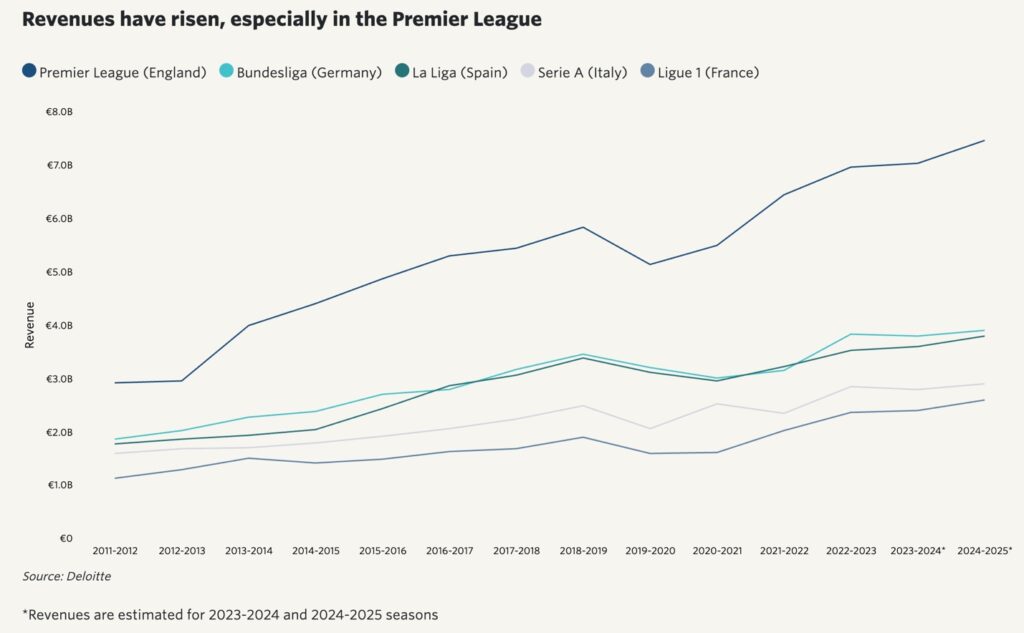
Private equity investment in professional football has expanded dramatically over the past decade, reshaping club ownership and league financing globally, with over €10bn invested by PE firms into European football since 2016. European football clubs—once regarded as trophy assets for billionaire owners—are increasingly seen as institutional-grade investments by financial sponsors. This surge in interest reflects a convergence of factors: record valuations and revenue growth in top leagues (with Premier League broadcasting rights alone exceeding £10bn for the 2022–2025 cycle, according to Statista), an abundance of available private capital, and a shifting mindset that football organisations can be run as profitable, growth-oriented businesses rather than merely prestige projects.
Macroeconomic trends and the COVID-19 pandemic have further accelerated this shift, making football more attractive to institutional investors. As traditional revenue streams faltered, cash-strapped clubs and leagues became more open to outside capital. The pandemic highlighted the fragility of football’s financial model and catalysed a trend already underway as PE firms stepped in with both liquidity and strategic expertise to tap into the sport’s long-term value.
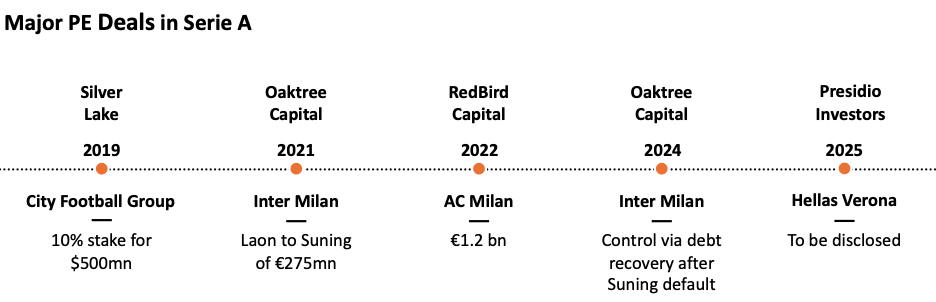
Several headline-grabbing deals since the late 2010s highlight private equity’s growing presence in football. Silver Lake’s $500 million investment in City Football Group and RedBird Capital’s €1.2 billion acquisition of AC Milan stand out among the most notable. Meanwhile, Chelsea’s record-breaking sale and major league-level deals in La Liga and Serie A reflect a broader trend of capital targeting both clubs and broadcasting revenues.
The influx of private capital is reshaping football, with clubs increasingly seen as valuable brands capable of sustainable growth. Investors are drawn to the sport’s vast fan base and global reach, seeing potential in modernisation and expansion.
Strategic Objectives of Private Equity in Football
Private equity investors enter the football industry with clear and deliberate strategic objectives. Their goal is to grow enterprise value within a defined investment horizon, typically through revenue expansion, operational efficiency, and eventual monetisation via exit. In the context of football, these objectives include:
Revenue Optimization and Commercial Growth
A central pillar of private equity strategy in football is to grow and diversify revenue streams. Clubs and leagues are encouraged to scale up high-margin income sources such as media rights, sponsorships, merchandising, and international licensing. Investors look to expand fan monetisation through global brand development, digital content, and international partnerships. With evolving viewer habits, direct-to-consumer broadcasting platforms and new content formats (e.g., behind-the-scenes documentaries) represent opportunities to engage fans and generate additional revenue. Sponsorship portfolios are broadened, stadium assets are better utilized, and commercial departments are often restructured to pursue international growth more aggressively.
PitchBook, Private Equity Connections to Europe’s Top Football Clubs Dashboard (2024).
https://pitchbook.com/news/articles/private-equity-european-football-dashboard
Operational Efficiency and Financial Discipline
PE firms bring disciplined financial management and cost control to an industry historically prone to inefficiencies. This includes streamlining operations, professionalising club structures, renegotiating supplier contracts, and optimising player wage expenditures. Clubs may adopt centralised decision-making models and modern data analytics to guide recruitment and performance management. The aim is to reduce wasteful spending and improve profitability without sacrificing competitiveness. Efficiency also extends to shared services and infrastructure development, such as training centres or medical facilities that will enhance long-term return on investment.
Digital Transformation and Fan Engagement
Technology plays a vital role in private equity’s football strategy. Investors recognise that clubs are sports entities and media and entertainment platforms. Enhanced fan engagement via digital platforms – including social media, mobile apps, and streaming services – opens up monetisation opportunities and fosters deeper brand loyalty. Clubs are pushed to collect and leverage fan data to personalise experiences and marketing. Private equity also supports investments in innovation, such as augmented reality experiences and fan tokens (e.g. for access to exclusive content or voting rights), aiming to enhance the emotional and commercial connection between clubs and their global audiences.
Commercial Exploitation of Brand and Assets
Many football clubs possess underutilised commercial assets. Private equity firms work to fully capitalise on a club’s brand equity, history, and physical infrastructure. This may involve stadium redevelopment, naming rights sales, expanded merchandising efforts, or opening overseas academies. Clubs are encouraged to act as global consumer brands, focusing on regional sponsorships, themed content, and heritage product lines. Additionally, brand expansion through global tours or foreign partnerships helps cultivate new revenue channels and fan bases.
Exit Strategy and Investment Horizon
Unlike legacy owners, private equity firms operate on a defined timeline. Exit planning is embedded in every strategic decision, from the choice of club or league to the scale of operational reform. Exit options may include selling the club or stake to a new investor, public listing, or sale to strategic buyers such as sovereign funds or sports conglomerates. A successful exit relies on driving up valuation through financial improvements and commercial growth. For example, the sale of AC Milan by Elliott Management to RedBird Capital demonstrated how disciplined restructuring and on-pitch success could generate substantial returns within a few years.
League vs. Club-Level Investment Strategies
Private equity’s approach in football varies between investing in individual clubs and engaging in league-level ventures. Club-level investments offer control and concentrated upside potential but also carry significant risk, particularly due to relegation. League-level investments, such as CVC’s deals with La Liga or the proposed Serie A media partnership, spread risk across multiple entities and provide exposure to broader media rights growth. These investments resemble infrastructure plays, aiming to grow the league’s commercial footprint, digitisation, and global brand presence. The choice of strategy depends on the investor’s appetite for risk, control, and return profile.
Silver Lake & City Football Group
In November 2019, Silver Lake Partners, a leading technology investment firm with over $102 billion in assets under management, made a significant investment in football. The Silicon Valley-based fund acquired a 10% stake in City Football Group (CFG), the holding company for clubs including Manchester City, New York City, and Girona, for $500 million. This deal valued CFG at $4.8 billion, positioning Manchester City among the world’s most valuable sports franchises.
CFG’s majority owner is Mansour bin Zayed Al Nahyan, a member of Abu Dhabi’s royal family. Since purchasing Manchester City in 2008, he invested hundreds of millions in acquiring world-class players and hiring renowned manager Pep Guardiola, leading the club to become the second-highest revenue-generating football team globally in the 2023–24 season, with approximately $872.32 million in revenue (Deloitte Football Money League 2025).
Silver Lake was attracted by football’s multi-billion-dollar revenues from TV and streaming rights, viewing technology as crucial for monetising fan engagement through apps offering exclusive content such as interviews, documentaries, and highlights. Manchester City had already capitalised on this with an Amazon Prime docuseries about their 2018 title win. However, some experts criticised Silver Lake’s timing, noting declining willingness among viewers in countries like Italy, the UK, and France to pay for televised matches. With media companies increasingly relying on online platforms, clubs were urged to diversify revenue streams, particularly through matchday and sponsorship income.
Criticism also arose regarding Silver Lake’s valuation of CFG, which was considered excessive compared to Forbes’ July 2019 valuation of Manchester City alone at $2.69 billion (ranked 25th). Silver Lake’s investment propelled CFG above the New York Yankees ($4.6 billion in 2019) but still behind the Dallas Cowboys ($5 billion).
Challenges & Criticisms of PE in European Football
Private equity (PE) has become increasingly entrenched in European football, bringing fresh capital but also considerable controversy. While new investments often help financially troubled clubs, embracing this model means addressing criticism. One major concern is that PE deals typically involve leveraged buyouts, placing debt on club balance sheets rather than investors’, increasing vulnerability if revenue from media rights, matchday income, or player sales falls short.
Additionally, PE faces cultural resistance as fans perceive investors as profit-driven entities lacking emotional connections to their teams. Trust erodes when short-term profits appear prioritised over long-term success. Governance also poses issues, given the frequent lack of transparency and public accountability, conflicting with football’s community ethos.
Silver Lake’s investment in City Football Group (CFG) exemplifies both the opportunities and tensions inherent in private equity’s football ventures. While the multi-club model offers marketing, data, and player development synergies, critics argue it risks diluting club identities and undermining competitive integrity. Regulatory complexities around ownership caps and UEFA’s conflict-of-interest concerns further complicate matters. CFG’s cumulative losses—$9.4 billion since 2013—highlight challenges in scaling football operations sustainably, despite Manchester City’s commercial success. Silver Lake’s ambition to monetise fan engagement through digital content faces difficulties amid declining TV audiences, illustrating PE’s broader dilemma of balancing aggressive growth strategies with football’s cultural values.
Future Outlook
Despite these criticisms, the long-term presence of PE in football seems likely. Global media deals, mark-ups and the rise of fans around the world are making clubs truly hot commodities. PE firms bring professional management, financial discipline and scalability that can unlock value in underperforming teams. So, the rules and regulations around spending could get a lot tighter. UEFA has some strict rules to prevent teams from spending recklessly and enforce long-term sustainability.
Bibliography
Bloomberg. Oaktree Gives Inter Milan a €47 Million Equity Injection (2024). https://www.bloomberg.com/news/articles/2024-09-25/oaktree-gives-inter-milan-a-47-million-equity-injection?embedded-checkout=true
Charzewski, Piotr; Starzyk, Agnieszka; Religa, Aleksandra. The Rising Role of Private Equity in Professional Sports: A Review (2025). https://apcz.umk.pl/QS/article/view/57874
Financial Times. RedBird Capital completes €1.2B acquisition of AC Milan (2022). https://www.ft.com/content/d07d4408-a448-4ed8-9083-2aeb0396d2ba
Front Office Sports. Silver Lake Buys Stake in Manchester City Owner (2022). https://frontofficesports.com/silver-lake-buys-stake-in-manchester-city-owner/
Modina, Leonardo. Private equity in football: How the arrival of funds has impacted the industry (2024). https://journals.francoangeli.it/index.php/cgrds/article/view/16943
Mosca, A. The AC Milan-UEFA Financial Fair Play Case: A Detailed Examination (2019). https://www.ruizcrespo.com/wp-content/uploads/2019/01/ruizcrespo-noticia-20190120-abogado-RDES.pdf
The Rio Times. City Football Group Bleeds $9.4 Billion Despite Manchester City’s Success (2025). https://www.riotimesonline.com/city-football-group-bleeds-9-4-billion-despite-manchester-citys-success/
Private Equity Insights. Rise of Multi-Club Ownership in Football: Private Equity’s Growing Influence and Regulatory Challenges (2024). https://pe-insights.com/rise-of-multi-club-ownership-in-football-private-equitys-growing-influence-and-regulatory-challenges/
Reuters. US Presidio Investors Takes Over Italy’s Hellas Verona (2025). https://www.reuters.com/sports/soccer/us-presidio-investors-takes-over-italys-hellas-verona-2025-01-15
Financial Times, Private equity eyes football’s financial distress (2021).
https://www.ft.com/content/6c60fb4b-0781-4da4-8652-651e8ad14c21
Bloomberg, How Silver Lake’s Stake in City Football Group Changed the Game (2020).
https://www.bloomberg.com/news/articles/2020-01-01/how-silver-lake-s-stake-in-city-football-group-changed-the-game
The Economist, Football is now a business – and private equity wants in (2023).
https://www.economist.com/business/2023/03/01/football-is-now-a-business-and-private-equity-wants-in



Comments are closed.