
Written by Felipe Mazur de Freitas
Introduction:
Sports has been an emerging sector within the American entertainment industry, showing consistent growth supported by the recent increase in international reach of major leagues such as the National Basketball Association (NBA), the National Football League (NFL), and Major League Baseball (MLB). As leagues grow in revenue and audience, their franchises have attracted interest from institutional investors, such as private equity firms, seeking to capitalize on the rising valuation of these teams. However, leagues limit how much of their franchises can be owned by a corporation.
| LEAGUE | ONE PE FUND | ALL PE FUNDS | TEAMS PER FUND |
| NBA | 20% | 30% | Up to 8 |
| NFL | 10% | 10% | Up to 6 |
| MLB | 20% | 30% | No cap |
| NHL | 20% | 30% | Up to 5 |
Figure: Table specifying restrictions on institutional ownership in the NBA, MLB, NFL, and NHL
Source: Akin
These restrictions are put in place for two main reasons, with the first being to preserve the traditional individual ownership structure that has been a staple of these leagues for their entire history, and the second being to protect the teams’ competitive and cultural identities. However, if we look into specific franchises, we can see that despite the restrictions, private equity firms have more control than the book suggests.
The Mechanism:
One question remains from the last paragraph: How do these firms circumvent these restrictions and gain major control over franchises? The trick that private equity firms use is that they don’t actually purchase the team directly; rather, they finance an individual or a group of individuals to purchase it on their behalf. Due to this, the formal owner is denoted as the individual who effectively bought the shares, fulfilling the leagues’ rules, while a significant share of the capital behind the transaction comes from the PE firm.
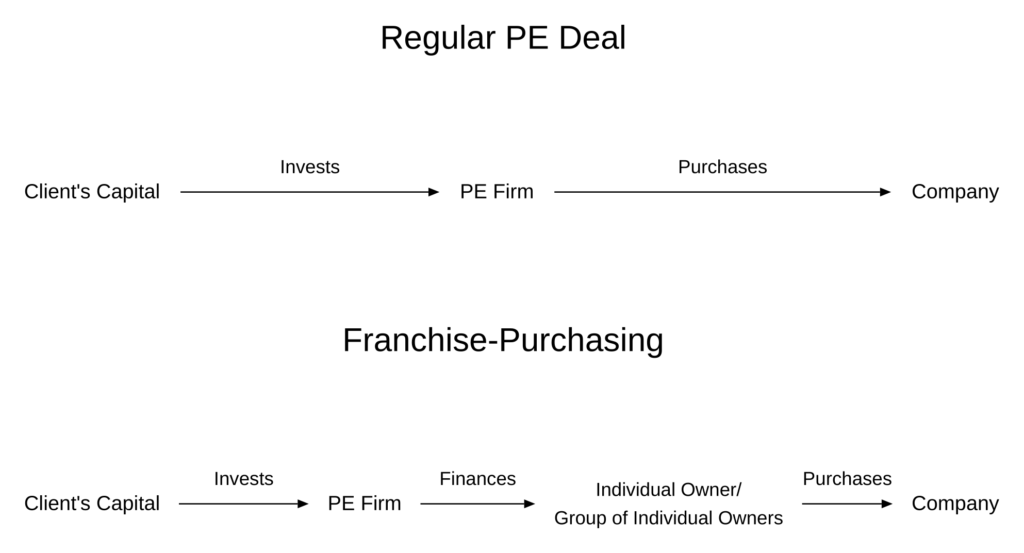
Figure: Diagram comparing a traditional private equity deal to one involving major league franchises
Source: Author’s own diagram
This mechanism is the overall process by which a private equity firm enters the ownership group of the franchises, but as we go on to study the specific cases where private equity holds major control within a team, we can see that this alone is not enough to bypass the leagues’ oversight.
Case Studies: How ownership affects fan experience
As we get into the case studies and analyze how private equity firms holding control over a team affect fan experience, it is crucial to state that it is impossible to know with certainty how ownership dynamics of a franchise work. What we can do is go through the facts behind the purchase and actions of the franchises to draw inferences.
Boston Celtics and Sixth Street:
Confirmed:
- Bill Chisholm, co-founder of private equity firm STG Partners, bought the Boston Celtics in August 2025.
- Chisholm needed external financing to complete the deal, and amongst other investors, Sixth Street, the private equity firm, was listed as a minority owner, with approximately 10% of the team.
- Sixth Street is also a minority owner of the San Antonio Spurs.
Reported:
- Multiple sources state that initially, Sixth Street invested more in the purchase than Chisholm, which violates the NBA’s rules. Despite this, the sale was announced with Chisholm as the lead buyer. This allowed him to raise capital from other investors and reduce Sixth Street’s original ownership, complying with the NBA’s rules.
- Multiple sources also state that Sixth Street negotiated its shares to be preferred, greatly increasing the amount of power it holds compared to a standard ownership structure.
What we can infer based on these reports:
- Sixth Street’s initial investment, which was allegedly bigger than Chisholm’s, was central to the deal being concluded. As a result of this, Sixth Street gained leverage within the Celtics, allowing it to negotiate a deal structure that expand their power beyond the 10% stated in the official announcement. *
* This is an interpretation and not a confirmed fact. Because the governance terms of the deal aren’t public, it isn’t possible to know how much influence Sixth Street holds.
Analysis:
Analyzing the Boston Celtics’ books since the purchase, we can see that the team’s revenue remained consistent with the trend, growing from $458m in 2025 to $511m in 2026. However, the team’s operating income nearly doubled, going from $116m in 2025 to $209m in 2026.
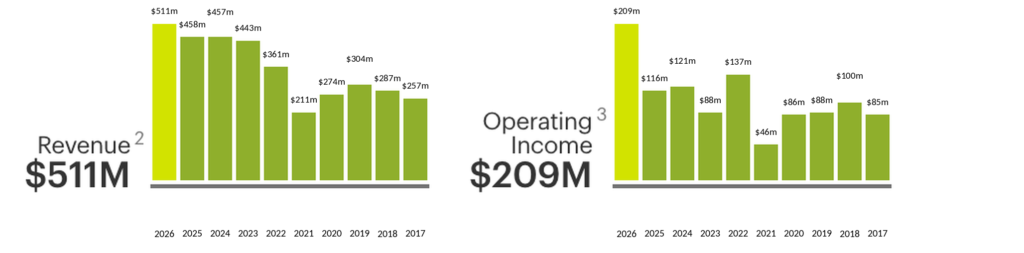
Figure: Boston Celtics Revenue and Operating Income 2017-2026
Source: Forbes NBA Team Valuation List
This indicates a sharp decrease in costs, which was the case, as the Celtics’ operating costs fell from roughly $342m to $302m. This is a textbook private equity strategy; you raise revenue while decreasing costs and greatly increase earnings. It all seems good on paper, but how does this approach affect the fans of the Celtics? To cut costs, the managers of the Celtics decided to trade key players from the 2024 Championship team, such as Jrue Holiday and Kristaps Porzingis in the 2025 off-season and, most notably, superstar player Jaylen Brown in the 2026 off-season. The goal of this was to reduce the team’s payroll below the NBA’s luxury threshold, saving owners approximately $52m. The Celtics’ new team underperformed in the 2025/2026 season and is not considered a major contender in the 2026/2027 season, leaving the fans questioning the ownership’s commitment to winning.
In addition, the power that Sixth Street allegedly holds within the Celtics creates a direct ethical conflict with the firm’s ownership stake in the San Antonio Spurs, as the company’s objectives may not consistently coincide with the competitive aspirations of either team.
Now this might lead the public to conclude that private equity control over franchises is always negative for the team’s fans; however, this is not always the case.
Los Angeles Dodgers and Guggenheim Partners:
Confirmed:
- Guggenheim Baseball Management acquired the Los Angeles Dodgers in 2012, with Mark Walter, CEO of Guggenheim Partners, as its controlling partner.
- Guggenheim Baseball Management, despite the similar name, has no legal connection to Guggenheim Partners.
- Under the new ownership, the Dodgers completed a $100m stadium renovation and have consistently had the highest payroll in MLB.
Reported:
- The Los Angeles Times reports that of the $2bn invested in the purchase, $1.2bn was funded by “Guggenheim Partners insurance companies controlled by Walter.”
What we can infer based on these reports:
- The Los Angeles Times report, Mark Walter’s roles as both controlling partner and CEO, and the continued investment in the franchise all support the inference that Guggenheim Partners was central to the purchase and is highly involved in the team’s decision-making. *
* This is an interpretation and not a confirmed fact. Because the governance terms of the deal aren’t public, it isn’t possible to know how much influence Guggenheim Partners holds.
Analysis:
Analyzing the Dodgers’ books, we can see a clear difference from the Boston Celtics. The Dodgers’ revenue consistently rises; however, the team’s operating income in 2026 was negative.
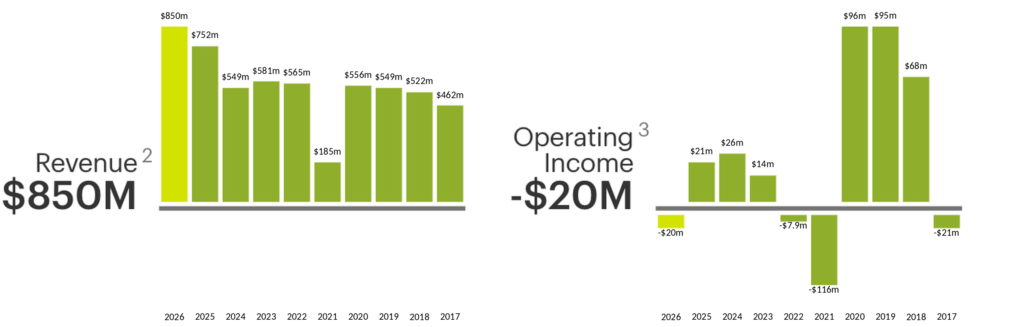
Figure: Dodgers Revenue and Operating Income 2017-2026
Source: Forbes MLB Team Valuation List
This is due to the high player expenses mentioned previously. Below is a graph that compares the Dodgers’ payroll with that of other MLB teams:
Figure: Dodgers 2025 payroll in comparison to the six MLB teams with the lowest payroll combined.
Source: MLB
The curious thing is that, despite the team’s negative income, its valuation has soared from a $2bn price tag in 2012 to $7.8bn in 2026. This is a result of Guggenheim understanding the business they were in and what truly raises the team’s valuation: fans. The ownership group renovated the stadium and brought in the best players in the league, which led the Dodgers to back-to-back MLB titles. The formula is simple and applicable across all sports: winning leads to fans, and fans lead to potential upside. The Dodgers now have one of the biggest fan bases in baseball, with a large percentage being international due to superstar players Shohei Ohtani and Yoshinobu Yamamoto. These fans can be monetized through merchandise, tickets, TV deals, and several other channels, raising the expected revenue in the coming years, which justifies the valuation.
Conclusion:
Despite restrictions, private equity firms have found a mechanism to gain control over franchises in the major American sports. In this structure, a private equity firm provides capital to an individual or a group to acquire a team, obtaining power through its financial support while the individual acts as the lead owner.
The Boston Celtics and the Los Angeles Dodgers, allegedly, are both examples of hidden private equity control, but despite this, their ownership structures and strategies vary. Based on the reports analyzed, Sixth Street controls the Celtics through initial financing of the purchase and the implementation of preferred shares, while Guggenheim Partners controls the Dodgers through external financing, utilizing their CEO as the face of the franchise.
In their approaches, the Celtics’ ownership prioritizes cutting costs, whereas the Dodgers’ ownership prioritizes high capital expenditure and maximizes the number of fans. The difference in results is also clear; the Celtics’ ownership faces heavy criticism from fans, while the Dodgers’ ownership has more than doubled its initial investment. One treats sports like any other business, while the other understands it is not driven by margins but by passion, and the results follow.
Bibliography:
Sports Business Journal, https://www.sportsbusinessjournal.com/Articles/2024/11/04/finance-private-equity-leagues/
NBA PR, https://pr.nba.com/nba-board-of-governors-celtics-sale-bill-chisholm/
Axios, https://www.axios.com/2025/03/26/boston-celtics-chisholm-private-equity
The Athletic, https://www.nytimes.com/athletic/6836781/2025/11/26/bill-chisholm-boston-celtics-owner-journey-nba/
Sixth Street, https://sixthstreet.com/investment-strategies/sports-media-entertainment
Forbes, https://www.forbes.com/teams/boston-celtics/
Forbes, https://www.forbes.com/teams/los-angeles-dodgers/
MLB, https://www.mlb.com/news/dodgers-sale-to-guggenheim-baseball-management-closed-c30125872
MLB, https://www.mlb.com/dodgers/news/dodger-stadium-enhancements-unveiled-for-2013-season/c-43506394
MLB, https://www.mlb.com/news/mlb-payroll-disparity
Blackstone, https://www.blackstone.com/news/press/guggenheim-baseball-management-acquires-los-angeles-dodgers/
LA Times, https://www.latimes.com/sports/la-xpm-2012-dec-16-la-sp-guggenheim-chart-20121216-story.html
YouGov, https://yougov.com/en-us/articles/54199-japan-interest-grows-in-mlb-wbc
Joon Lee, https://joon.me/writing/the-game-is-never-just-the-game
Joon Lee, https://www.youtube.com/watch?v=taaj-jBeCOk&t=663s



Comments are closed.