
Written by Maciej Skorupka, Juliette Bourgeois and Vittorio Sigillò Massara
The global energy landscape is undergoing a profound transformation, driven by the urgent need to shift toward cleaner energy and reduce carbon emissions. The rapid expansion of renewable energy sources, such as wind and solar power, lies at the heart of this transition. However, the intermittency and variability inherent in these renewable sources pose significant challenges to the stability and reliability of electrical systems. As the share of renewable energy increases in the energy mix, grid operators are increasingly faced with complex tasks such as balancing supply and demand, regulating frequency, and maintaining overall grid stability. Battery Energy Storage Systems (BESS) have emerged as a key solution to these challenges. BESS can store excess energy generated during periods of high renewable production and release it during periods of low production or high demand, thereby helping to smooth out fluctuations in energy output.
Battery storage is unlocking the full potential of renewable energy
Lithium-ion batteries, known for their use in mobile phones and electric vehicles, are the dominant technology in large-scale energy storage. Their popularity in battery storage systems can be explained by several advantages: high energy density, long lifespan, charge-discharge efficiency above 90 percent, and the ability to respond quickly to changes in demand. Within power grids, these batteries play a crucial role. They make it possible to store surplus electricity produced especially by renewable sources such as solar energy (during the day) or wind power (when the wind blows), and to inject it back into the grid when production decreases or demand increases. This flexibility ensures stable electricity supply despite the natural variability of renewable sources.
Today, battery storage systems are experiencing remarkable growth, marking a 53 percent year-over-year increase in 2024, with global installed capacity reaching 205 GWh. Lithium-ion technology was the clear leader, representing 98 percent of grid-scale installations. This rapid expansion has not only reshaped the energy infrastructure landscape but also captured the attention of private equity and financial investors, who now regard BESS as a strategic, high-growth investment opportunity.
Battery storage is reshaping PE strategies in the energy transition
BESS is emerging as a key investment frontier within the energy transition as the PE industry is seeking exposure to scalable, ESG-aligned infrastructure assets. While BESS supports global decarbonisation, improves grid reliability, and bolsters energy security, these benefits are increasingly being viewed through a commercial lens. The market’s accelerating maturity, combined with favourable policy tailwinds and growing demand for flexible power solutions, is creating a compelling environment for PE investment.
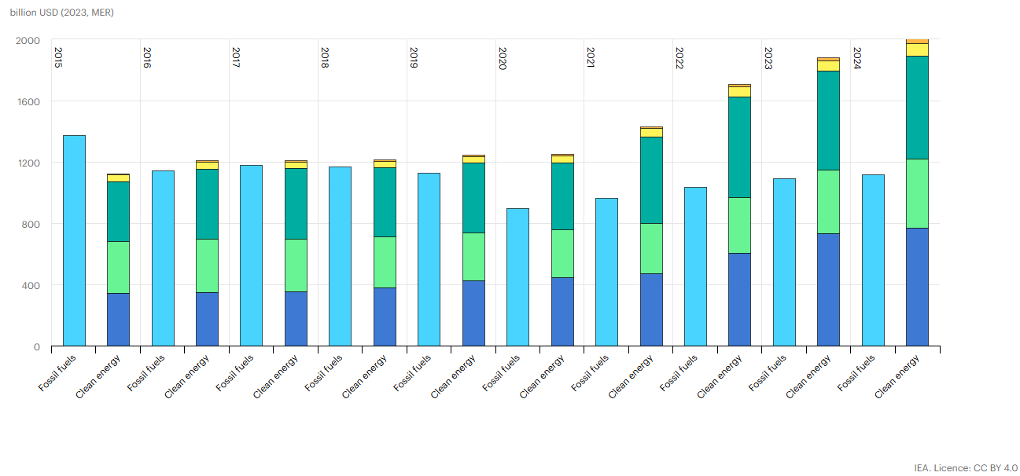
For PE, BESS offers a rare convergence of long-term infrastructure stability with the high-growth potential more typical of technology sectors. Market fundamentals are strong: in 2024, over $2tn of global energy investment is expected to be directed towards clean energy (including battery storage) underscoring the sector’s growing importance. BESS revenue streams are also diversifying, with opportunities across grid services, capacity markets, and merchant arbitrage. These attributes make the sector increasingly attractive to infrastructure and growth-oriented PE strategies.
Battery storage is charging ahead with record-breaking growth
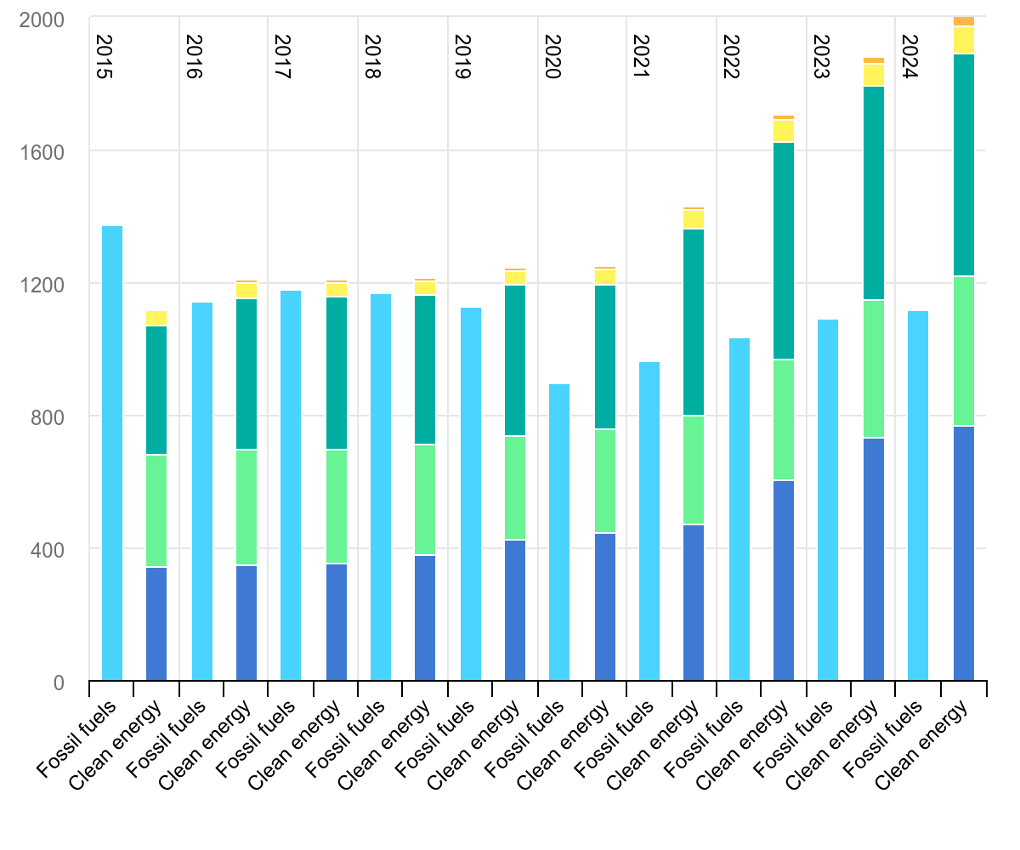
billion USD (2023, MER)
PE firms are under pressure to demonstrate ESG value creation—and energy storage is rapidly being recognised as a lever for delivering measurable carbon reduction while maintaining competitive returns. The sector’s alignment with ESG goals is not just theoretical: Q1 2024 alone saw 69 M&A transactions involving BESS, a strong indicator of buy-side momentum and liquidity.
Policy is another accelerator. Tax credits introduced via the U.S. Inflation Reduction Act, and similar incentives in Europe and Asia, are lowering entry barriers and improving the economics of storage investment. These mechanisms de-risk capital deployment and make BESS a more bankable asset class for PE-backed platforms and roll-up strategies.
Strategically, BESS also enables vertical integration within clean energy portfolios. PE-backed independent power producers (IPPs), developers, and platform plays are increasingly incorporating storage into their renewable project pipelines. This not only enhances asset flexibility and yield, but also improves exit options in an increasingly storage-centric energy market.
BESS is no longer a niche technology—it is a maturing asset class at the intersection of energy, infrastructure, and innovation. For PE investors, the question is less about “if” and more about “how” to capture value as the market scales. This sets a strong foundation for a deeper dive into investment models, return profiles, and risk mitigation in the next section.
KKR’s Strategic BESS Investment
In October 2024, KKR made a significant step in its sustainable energy strategy by committing $450 million in a debt financing deal, aimed at supporting the rapid expansion of battery energy storage systems (BESS). This investment involves two key players: Powin and Peregrine, both operating in the clean energy sector across the United States.
Powin, a leading provider of energy storage systems, received $200 million via a revolving credit facility from the deal. This funding will support the growth of Powin’s proprietary technology platform, which has already been deployed in over 16 U.S. states and operates in eight countries globally. The company has delivered more than 17 GWh of BESS systems, either operational or under construction, positioning Powin as one of the most prominent system integrators globally. Powin’s proprietary technology platform is central to advancing energy storage systems, enabling scalable deployment and enhancing grid reliability across the markets it serves.
In addition to Powin, Peregrine, a developer specializing in clean energy and storage projects, also secured up to $250 million. The investment will enable Peregrine to build 37 utility-scale energy storage facilities across 11 U.S. states. These projects, with a combined projected capacity of more than 22 GWh, will play a crucial role in stabilizing the energy grid and supporting the integration of renewable energy sources in deregulated markets such as ERCOT and WECC. The flexibility provided by energy storage systems is essential in these markets, where grid balance and the management of renewable energy intermittency are crucial challenges.
This deal is structured as debt financing, facilitated through insurance accounts managed by KKR in collaboration with SMBC (Sumitomo Mitsui Banking Corporation). Debt financing, as opposed to equity investment, allows KKR to provide capital without taking ownership stakes in the companies, thus creating an opportunity for Powin and Peregrine to access the necessary funding while maintaining control over their operations.
KKR’s investment strategy is aligned with the broader trend of integrating sustainability into finance. Emmanuel Lagrargue, co-lead of KKR’s climate strategy, emphasized that energy storage has become one of the most tangible solutions to accelerate decarbonization in high-emission sectors. KKR views batteries as “the new solar” in terms of expected returns and technological maturity, positioning energy storage as a key component of its clean energy vision. This investment follows KKR’s earlier entry into the BESS sector through its 2023 majority stake acquisition in Zenobē, a UK-based leader in grid-scale battery storage and EV fleet electrification, valued at approximately $750 million. Over the past 15 years, KKR has allocated more than $34 billion to sustainable projects and currently manages more than $600 billion in assets, leveraging both its financial strength and industrial expertise to rapidly scale clean technologies.
PE is fueling the battery boom that is powering the clean energy revolution
KKR’s progressive expansion into BESS as an investment highlights the broader trend that even the PE industry is now reflecting corporate environmental responsibilities.This deal with Powin and Peregrine marks an important evolution in the role of PE in driving sustainable investments. The BESS market is expected to triple by 2030, reaching more than 330 GW of installed capacity worldwide. Initiatives like this reflect the shift in private capital mobilization towards supporting the clean energy transition.
Sources
National Grid. (n.d.). What is battery storage? Retrieved April 1, 2025, from https://www.nationalgrid.com/stories/energy-explained/what-is-battery-storage
Discover Battery. (n.d.). Understanding charging. Retrieved April 1, 2025, from https://blog.discoverbattery.com/understanding-charging
Energy Storage News. (2024). Global BESS deployments soared 53% in 2024. Retrieved April 1, 2025, from https://www.energy-storage.news/global-bess-deployments-soared-53-in-2024/
CyberGrid. (n.d.). BESS opportunities and feasibility analysis. Retrieved April 1, 2025, from https://www.cyber-grid.com/knowledge/bess-opportunities-and-feasibility-analysis
Overview of BESS market International Energy Agency
https://www.iea.org/reports/world-energy-investment-2024/overview-and-key-findings
Battery storage M&A powers into 2024
https://mergers.whitecase.com/highlights/battery-storage-ma-powers-into-2024
Utility-scale battery storage opens up for investors
https://www.jll.com/en-us/insights/utility-scale-battery-storage-opens-up-for-investors
Batteries Are the ‘Next Solar’ for Investors, Says KKR: https://about.bnef.com/blog/batteries-are-the-next-solar-for-investors-says-kkr
KKR provides US$450 million debt financing for US BESS firms Powin and Peregrine: https://www.energy-storage.news/kkr-provides-us450-million-debt-financing-for-us-bess-firms-powin-and-peregrine
Peregrine Closes on Debt Financing from KKR: https://www.prnewswire.com/news-releases/peregrine-closes-on-debt-financing-from-kkr-302266099.html
Powin Secures $200 Million in Debt Capital from KKR to Bolster Growth and Innovation in Energy Storage. https://powin.com/powin-secures-200-million-in-debt-capital-from-kkr-to-bolster-growth-and-innovation-in-energy-storage/



Comments are closed.